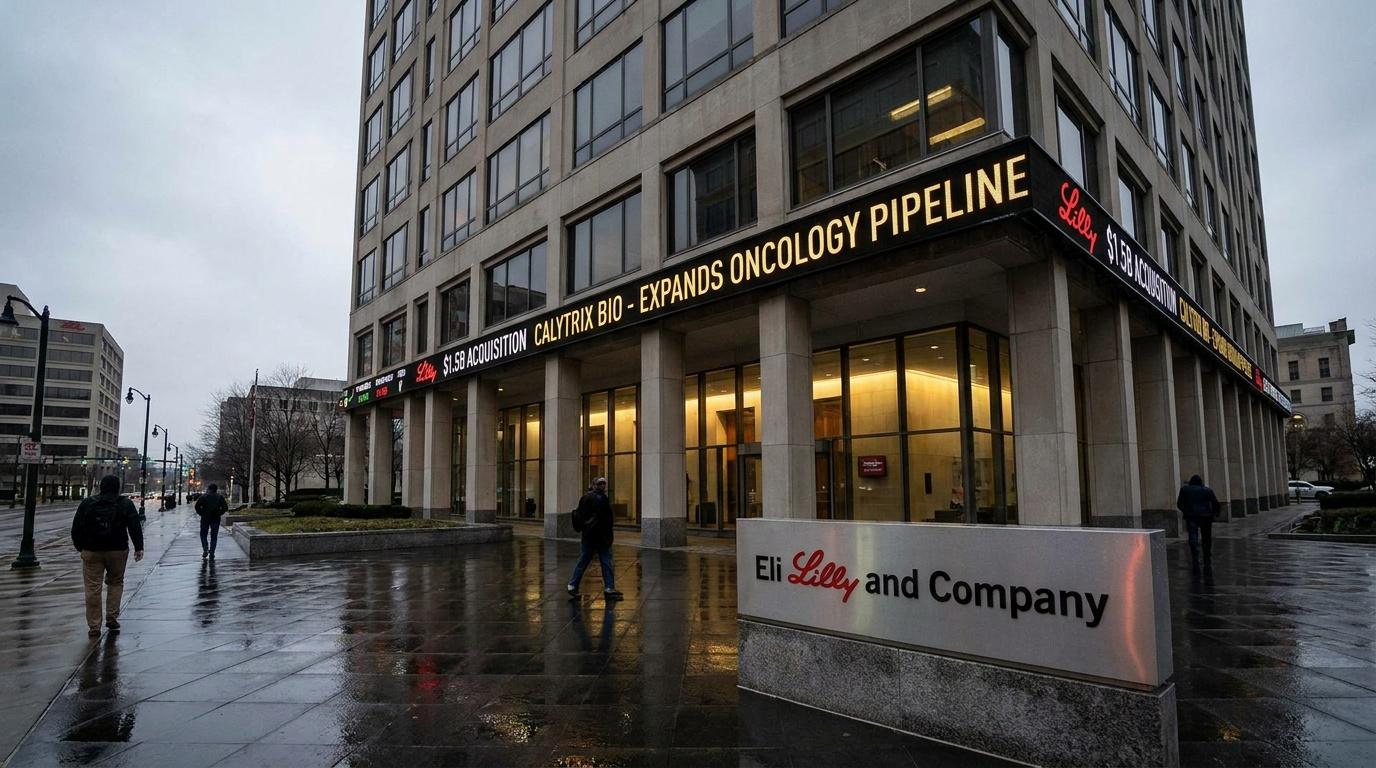
Eli Lilly has agreed to acquire privately held Calytrix Bio in a cash deal worth up to $1.5 billion, continuing the company’s push to add external pipeline assets after executives said last month they expected to do more buyouts. The transaction includes an upfront payment and additional milestone-based payments for certain clinical and regulatory events, but Lilly did not disclose the exact split.
Calytrix is focused on chronic blood cancers, and its lead program is a biparatopic antibody for mutant calreticulin-driven essential thrombocythemia and myelofibrosis, both myeloproliferative neoplasms. The candidate was not named in the release, but Calytrix said it is intended to be disease-modifying and to carry a safety profile that can support early and long-term treatment.
Why Lilly Bought It
The scientific pitch behind the asset is straightforward: Calytrix is targeting diseases where treatment typically centers on managing symptoms and complications rather than addressing the underlying disease. For Lilly, that creates room for a differentiated hematology bet inside a broader oncology franchise that the company said delivered 100% growth for key products in the third quarter.
The more important signal is strategic. During an October earnings report, Jacob Van Naarden, Lilly’s president of oncology and head of corporate business development, said the company was prepared to take on more risk in dealmaking, adding that “Risk is really our friend here. Risk allows us to actually create value.” Calytrix fits that description as an earlier-stage, private-company acquisition rather than a late-stage de-risked purchase.
The Broader Deal Pattern
Calytrix launched in 2025 out of J.P. Morgan Life Sciences Private Capital, the life sciences venture capital arm of J.P. Morgan Asset Management. The company completed a series A led by that firm and a series B with Avoro Ventures, though financial terms for those financings were not disclosed.
The acquisition is Lilly’s 14th disclosed transaction of the year. BioSpace said Lilly most recently bought autoimmune-focused Merida Biosciences for just under $2.9 billion in cash at the end of August, while its largest deal this year was the $8.14 billion March acquisition of Centessa Pharmaceuticals. In that context, Calytrix looks less like an isolated oncology add-on and more like evidence that Lilly is actively using its balance sheet to buy optionality across development stages.