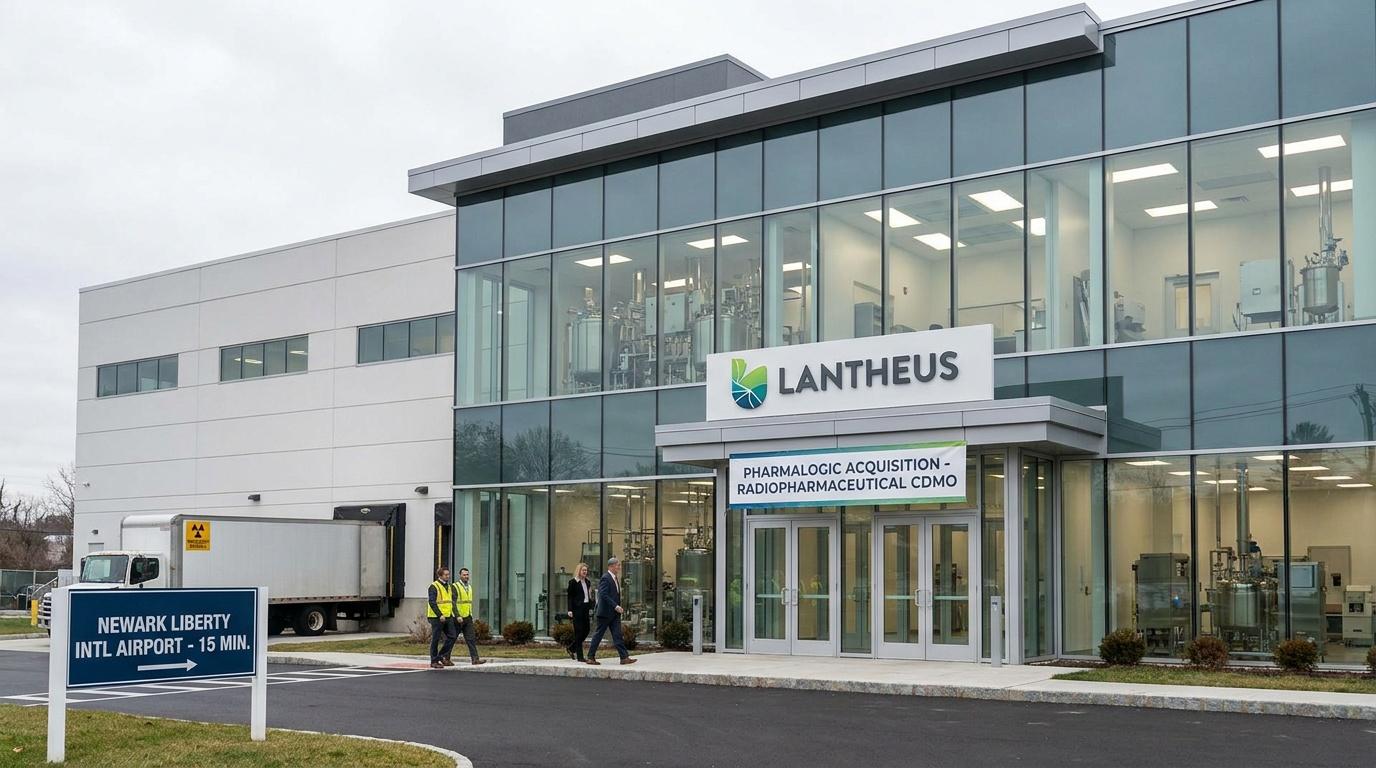
PharmaLogic has agreed to buy a radiopharmaceutical contract development and manufacturing organization and production plant from Lantheus, adding a U.S. site to the European position it established last year through a majority-stake acquisition in Norway’s Agilera Pharma.
The price was not disclosed. PharmaLogic said the Springfield, New Jersey, facility will make it the first therapeutic CDMO to offer a transatlantic platform, a strategic pitch aimed at drugmakers trying to secure manufacturing and distribution for radiopharmaceutical therapies.
Why The Asset Matters
The Springfield plant is a 14,000-square-foot manufacturing facility that Evergreen completed in 2021. It includes seven commercial-scale production suites and was designed to support manufacturing with multiple isotopes, including beta emitters such as the lutetium used in Novartis’ Lutathera and Pluvicto, as well as alpha emitters used in several next-generation drug candidates.
The facility can support projects from early-stage trials through commercial manufacturing. Its location about 15 minutes from Newark’s international airport also matters in a category where products can decay in days, making speed in distribution part of the manufacturing proposition rather than a separate logistics issue.
Employees at the Springfield site will join Agilera, which will make lutetium Lu 177 dotatate for Lantheus. That detail suggests the divestiture is not a full retreat from the site’s output for Lantheus, but a restructuring of how that capacity is held and operated.
The Strategic Context
Lantheus obtained the CDMO and plant last year when it bought Evergreen Theragnostics for $250 million upfront, calling Evergreen’s radioligand therapy manufacturing infrastructure and revenue-generating CDMO a boost to its business at the time. Selling those assets 19 months later stands out because the radiopharmaceutical field is still expanding rather than consolidating around excess capacity.
That expansion is visible in recent competitive moves. Last month, Lantheus and Curium won FDA approvals for drugs that could challenge Lutathera, while AstraZeneca, Bristol Myers Squibb and Eli Lilly all have radiopharmaceuticals in development.
The signal from this transaction is that control of supply may be taking different forms. Rather than every developer building fully in-house infrastructure, specialized manufacturing networks may become more central, especially for companies that lack their own radioisotope capacity. BioSpace cited a recent Sleuth prediction that companies without in-house infrastructure will likely succeed only as partners or acquisition targets for companies with established supply chains, while outsourcing could reduce the need to build that capacity internally.
Lantheus is making the sale while it works to complete its $8 billion merger with Curium, which was agreed in August and is scheduled to close in the first half of 2027. Curium has lutetium manufacturing capacity, making the offload easier to read as portfolio reshaping tied to that pending combination.