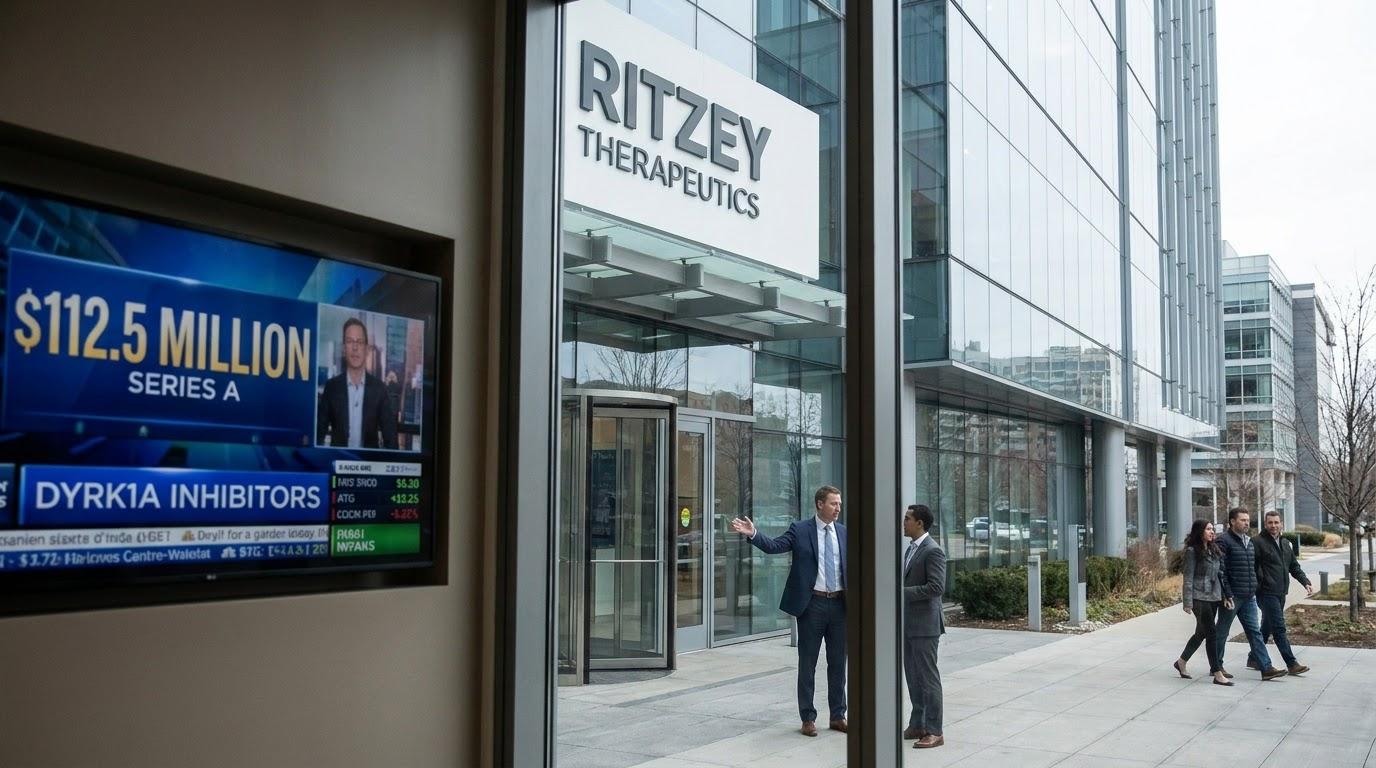
Ritzey Therapeutics has emerged with $112.5 million in series A financing and a pipeline centered on DYRK1A inhibitors, giving Sharon Mates a new platform after Johnson & Johnson acquired Intra-Cellular Therapies for $14.6 billion in early 2025, or last year as one source described it. The company said the financing will support a clinical-stage, once-daily oral lead program and broader work in chronic metabolic and neurologic diseases.
The launch matters less as a standard biotech debut than as a capital allocation signal: investors are backing an experienced management team to build around a defined intracellular target rather than a broad platform story. That mirrors the operating history that made Intra-Cellular an acquisition target, with Mates and former members of that company’s senior leadership team now applying a similar pathway-focused approach at a new company.
The program
Ritzey’s lead candidate came from the recently completed acquisition of France’s Perha Pharmaceuticals, though Ritzey did not disclose the buyout terms. The company said the asset has already completed early-stage clinical development and is being moved into phase 2 testing.
The development plan has two main tracks. In Down syndrome, Ritzey plans to study the candidate’s effects on pancreatic beta cell function and tau pathology. In the general population, it plans to evaluate pancreatic beta cell function in both type 1 and type 2 diabetes.
Across the source reports, the biological rationale is consistent. DYRK1A is a protein kinase on chromosome 21 that regulates cell growth and acts as what Ritzey described as a master brake on pancreatic beta cell expansion and function, while also affecting neuronal and inflammatory processes. Because people with Down syndrome have three copies of chromosome 21, DYRK1A is overexpressed, which Ritzey links to insulin insufficiency and increased pTau, described as an early predictor of Alzheimer’s disease. One source also noted that overexpression can contribute to cognitive dysfunction and tau hyperphosphorylation.
The financing picture
Vida Ventures led the round. Both reports said Fidelity Management & Research participated, while the broader syndicate named across the coverage also included Alexandria Ventures, EcoR1 Capital and Perceptive Advisors.
For investors, the attraction is not only the target biology but the combination of a clinical-stage starting point and a team with a recent large exit. Mates previously led the development and commercialization of Caplyta, the once-daily oral atypical antipsychotic approved in schizophrenia, bipolar I or II depression and major depressive disorder. Ritzey is now trying to transfer that execution record into diseases where a small-molecule oral approach could be commercially meaningful if the mechanism translates in mid-stage studies.
The immediate test is whether the Perha-derived program can show that DYRK1A inhibition affects the specific functional measures Ritzey has chosen in Down syndrome and diabetes. If it can, the company will have turned a well-funded launch into a differentiated clinical thesis rather than just a founder-driven financing event.