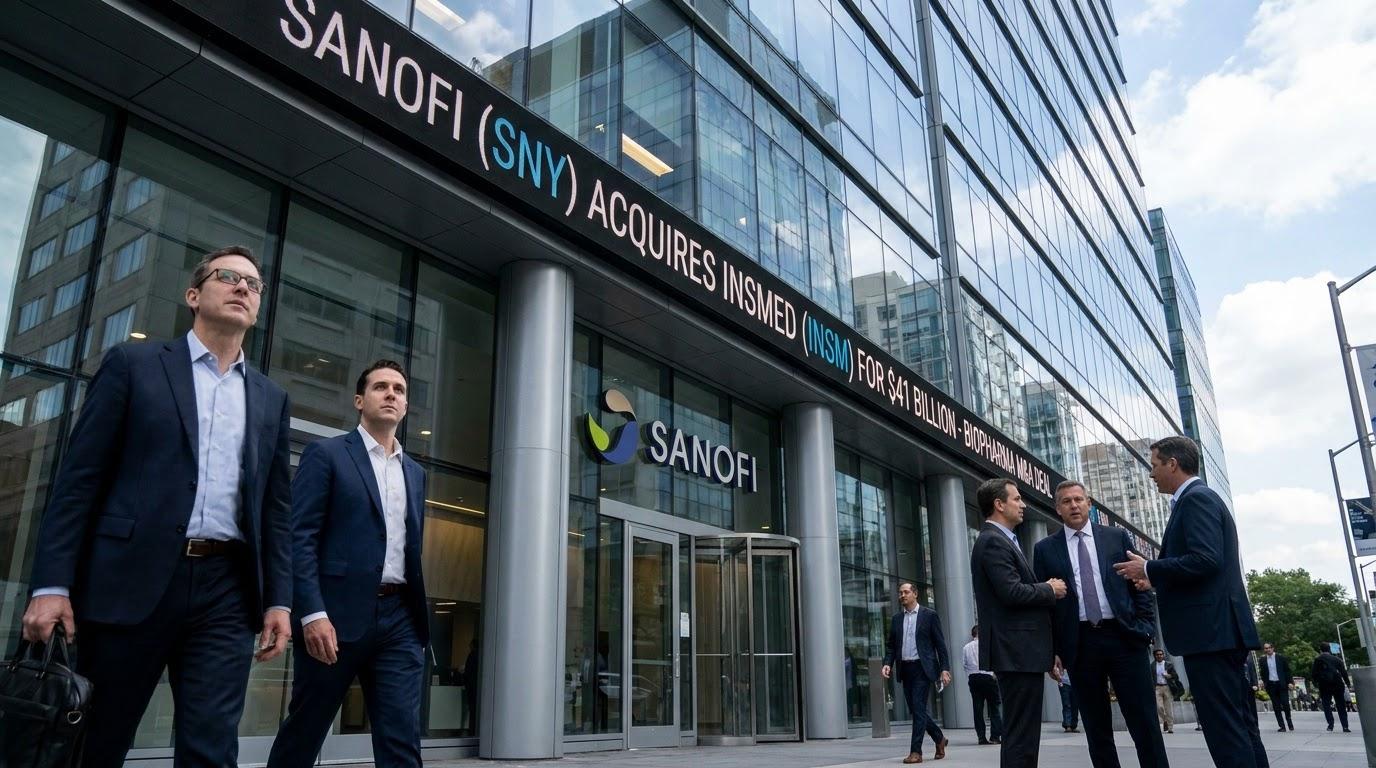
Sanofi has agreed to acquire Insmed for $41 billion in cash, giving new CEO Belén Garijo the biggest biopharma acquisition of 2026 less than seven full months after taking the role in May. Sanofi said it will pay $175 per share, a 46% premium on Insmed’s Nov. 18 closing price.
The size alone makes the deal notable. BioSpace described it as Sanofi’s second largest acquisition ever, behind the 2004 Aventis deal at $69.3 billion, and the biggest transaction in the sector since Pfizer’s $44.5 billion Seagen purchase in 2023. Strategically, the rationale is more specific: Sanofi is trying to strengthen its growth outlook before Dupixent reaches its patent cliff.
Garijo said on a Tuesday morning conference call that Insmed is not an isolated move but a critical step in a strategy already under way. She also called it an “anchor acquisition” and signaled that, after integrating Insmed, Sanofi could return to smaller bolt-on deals focused on preclinical to Phase 2 companies. That framing suggests the company sees Insmed less as opportunistic scale and more as a platform purchase around respiratory disease and immunology.
The Commercial Picture
The key assets are Insmed’s approved products Brinsupri and Arikayce. Brinsupri, approved in August 2025 for non-cystic fibrosis bronchiectasis, has generated $1 billion in its first four quarters on the market, including $500 million in the third quarter, according to the source report. Sanofi sees another 500,000 adults who could be reached with the therapy, while only 32,000 have been treated so far.
Arikayce, approved in 2018 for second-line refractory MAC lung disease, booked $460 million in full-year 2025 revenue. Insmed also brings a pipeline spanning respiratory disease, immunology and inflammation, neurological disease and rare disease.
BMO Capital Markets said the strategic fit is attractive because Brinsupri gives Sanofi a fast-growing respiratory franchise ahead of Dupixent’s patent expiry, while Arikayce adds durable revenue growth. Leerink Partners went further, writing that the acquisition should significantly offset the Dupixent patent cliff in a base case scenario and fully offset it in a bull case scenario. Leerink models total Dupixent revenue at about $30.7 billion for 2030, with profits split between the partners, and said Insmed could bring $13.9 billion in revenue to Sanofi by 2035.
For Sanofi, that is the core signal. The company is not merely buying revenue; it is trying to rebalance dependence on a single blockbuster franchise with products that already have commercial traction and room to expand.
The Road Here
The deal had been rumored in recent weeks, and Tuesday’s announcement confirmed it. Insmed shares rose more than 14% to $170.38 after the news, while Sanofi gained more than 8% to $50.90. Insmed had traded as high as $211 in late 2025, a point Sanofi CFO François Roger referenced when defending the premium. He compared the 46% premium to those paid in AstraZeneca’s Alexion acquisition in 2021 and Pfizer’s Seagen deal in 2023, and added, “We came in at the right time.”
The agreement does not include contingent value rights. BMO noted that milestone payments could have left room for another bidder, and Leerink said it could not rule out a higher competing offer, even though topping bids after biotech M&A announcements are extremely uncommon.
Sanofi has been preparing for the post-Dupixent era through other channels as well. In October, it extended its Regeneron partnership by another $1 billion to search for a successor to Dupixent. Garijo said the Insmed acquisition will be separate from, but complementary to, that alliance, which remains focused on dermatology and allergy. She also said Regeneron leadership was not consulted during negotiations, although she informed Regeneron CEO Leonard Schleifer before the formal announcement.
The acquisition also follows Sanofi’s nearly $10 billion Blueprint Medicines deal in 2025. Garijo said Insmed will help Sanofi build its own immunology capabilities outside the alliance structure. If the transaction closes in the first half of 2027 as planned, Sanofi will be betting that direct control over a broader respiratory and immunology base is the cleaner answer to its next decade of growth than continued reliance on one dominant partnered product.